63% report higher RFP volumes – but up to 20% go unfinished due to resource constraints as proposal teams see 25 to 50% workload spikes
SEATTLE, WA / ACCESS Newswire / February 25, 2026 / As B2B buying has become more structured, consensus-driven and risk-averse, proposals and RFPs have moved from a back-office task to a primary driver of revenue at professional services firms, according to new research from QorusDocs, a leader in AI-powered value and proposal management software. Once viewed as a downstream support function, proposal management, now directly shapes pipeline health, win rates and revenue outcomes.
As AI disrupts the traditional billable-hour model and prompts corporate clients to question fees, proposal operations have emerged as a critical lever to protect margins and capture growth. However, growing RFP volumes have driven a 25 to 50% workload spike for proposal teams at most organizations.
“Time, not intent, has become the primary constraint for modern proposal teams,” said Ray Meiring, CEO of QorusDocs. “Organizations believe in formal pursuits and see clear revenue upside, but many simply can’t respond to everything that hits their desk-and that gap now shows up directly in revenue risk exposure.”
As a growing share of revenue decisions move through formal RFPs, inefficiency becomes a measurable business risk. Large deal sizes, intense competition and capacity limits collide, turning day‑to‑day proposal work into a C‑suite issue.
Key findings from the QorusDocs 10th Annual Proposal Management Survey
-
Proposal and RFP volume keep climbing. 68% of respondents reported year‑over‑year increases in proposals, and 63% said they responded to more RFPs. Most growing firms added 6-10 new proposals or RFPs per month, while the average response still takes 6-10 days and nearly a third (31%) say 21 or more people are regularly involved in responses. As a result, most organizations saw workloads spike between 25 and 50%.
-
RFPs are now a primary revenue gateway. More than four in five respondents (82%) said they win 25 to 75% of new business through RFPs, underscoring the central role formal responses play in revenue generation. A majority said at least half of both new and existing client sales come from winning RFPs, meaning proposal effectiveness now governs how much revenue firms are even eligible to capture.
-
Value proof is now table stakes. Almost 90% of respondents say including ROI or business cases is important to their proposal process, reflecting buyers’ demand for clear, quantified outcomes rather than generic capabilities.
-
AI is delivering efficiency – but adoption is uneven. 73% of organizations have automated at least a quarter of their proposal process, and 29% have automated at least half, yet 28% still have little automation in place. For 60% of organizations, AI enables greater response volume, while 35% already credit AI with higher win rates and revenue.
-
Capacity gaps put millions in revenue at risk. Most organizations are unable to respond to between 10 and 20% of incoming RFPs due to time or resource constraints. Given typical volumes and deal sizes, missing just one response per month can expose teams to an estimated $1.2 million to $60 million in potential annual revenue loss.
-
Execution, not content creation, is the main bottleneck. Top pain points include SME delays (48%), time spent locating and maintaining content (46%) and responding on time (42%), followed closely by personalization (41%) and the lack of a centralized content solution (40%). More than a quarter say measuring effectiveness remains elusive, making it hard to know which messages and content actually drive wins.
-
Proposal work happens in Microsoft software. Most organizations still rely on Microsoft tools like Word (53%), PowerPoint (18%) and Excel (11%) to draft proposals, reflecting deep-seated workflows that demand integrated automation – not new tools – to coordinate across large teams, govern content and enable reuse at scale more efficiently.
-
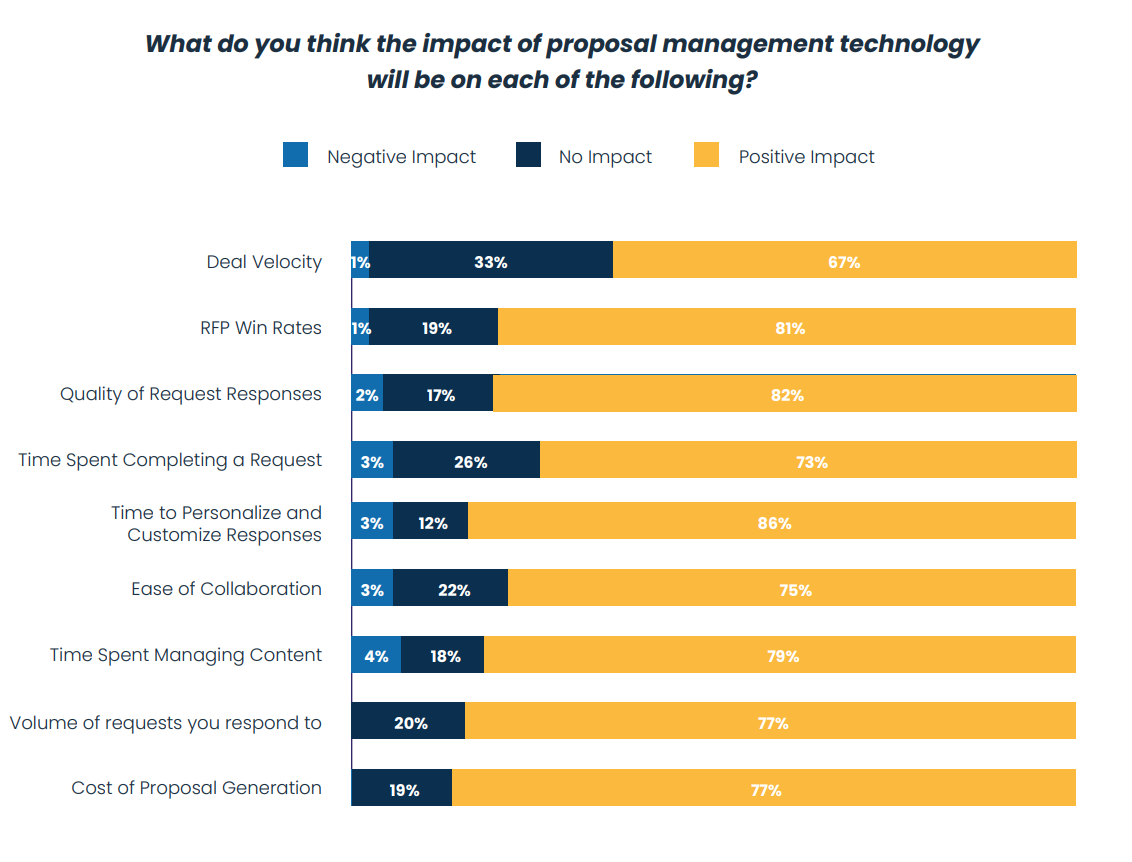
Expectations for proposal AI and automation are sky-high. 81% of respondents expect proposal management software to lead to higher RFP win rates, while 73% expect to complete requests faster, 67% anticipate faster deal velocity, and 77% expect lower proposal generation costs. In terms of process, 86% expect AI to improve the time required to personalize and customer RFP responses, while 82% anticipate improvements in response quality and 79% expect reduced time spent managing content.
“The next phase of proposal work won’t be defined by who uses AI, but by who turns AI into a coordinated system,” Meiring added. “Firms that integrate AI across people, content and process will be able to scale without scaling risk; those that treat it as a bolt‑on feature will hit a ceiling.”
About the Research
The QorusDocs 10th Annual Proposal Management Survey is based on a survey of 297 professionals involved in proposal creation, RFP responses, and proposal management software decisions at organizations with 100 to 5,000+ employees. Respondents span professional services (26%), legal services (24%), architecture, engineering, and construction (20%), IT services (19%) and financial services (4%), reflecting the day‑to‑day realities of proposal‑driven teams across multiple industries.
Click here to download the QorusDocs 10th Annual Proposal Management Survey.
About QorusDocs
QorusDocs is an automated Value and Proposal Management platform that unites value management with proposal automation. Built for professional services, legal, technology services and AEC organizations, the platform supports intelligent business cases and personalized, data driven pitches, presentations, proposals and RFP responses. Trusted by more than 200 organizations, QorusDocs helps firms prove ROI, optimize billable hours, and win more business. The company operates globally, with offices in Bellevue, Washington, London, England and Cape Town, South Africa.
PR Contact
Anna Rice
anna.rice@alpinemarketingcomms.com
SOURCE: QorusDocs
View the original press release on ACCESS Newswire