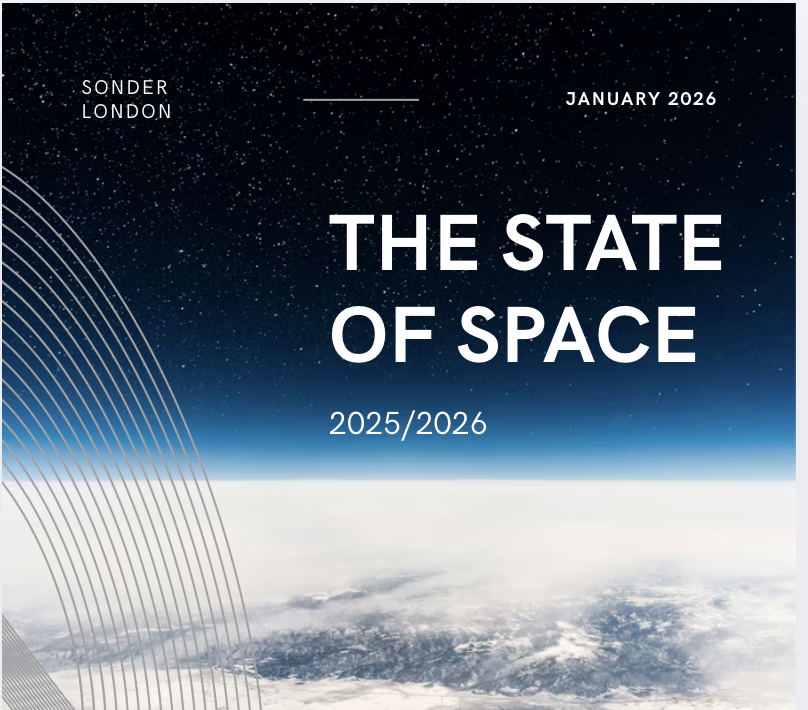
LONDON, GREATER LONDON, UNITED KINGDOM, January 26, 2026 /EINPresswire.com/ — A landmark report that brings together more than two dozen senior figures from across the public and private sector argues that space has become ‘critical infrastructure’ – and that policy, capital, communication and ambition must catch up.
The State of Space, published by space communications and strategic advisory firm Sonder London in partnership with space-focused private equity firm NewSpace Capital, argues that the sector has reached industrial scale. Space systems now operate continuously, globally, and at a scale that make them indispensable to modern life, underpinning communications, navigation, climate monitoring, disaster response, insurance, finance, and defence.
The report, which opens with a foreword from the UK Space Minister, Baroness Lloyd of Effra CBE, shows that in 2025 alone, more than 3,000 spacecraft were launched worldwide. Constellations replaced standalone satellites as the basic unit of competition. Launch became routine, shifting the sector’s focus towards linking systems, repeating processes, and reliably providing services to large numbers of users at low cost.
This shift is changing how investors view space. It is no longer a gamble or a one-off bet: companies are making real money, customers are global, and demand for services that run all the time continues to rise. The space market, already worth about $600 billion, could reach $1.8 trillion by 2035. The change looks like the early days of the internet, when a niche industry became basic infrastructure.
The authors also discuss the hurdles the sector faces. Failure is now more costly, and with space a contested domain, systems have to be highly resilient, secure and dependable under stress. More and more, space is tied to defence, and ‘dual-use’ systems – which have both civilian and military uses – are becoming the norm. With orbit growing more crowded, coordination also matters more than ever. For these reasons, the report argues for patient long-term investment, clearer rules and regulation, and closer cooperation between governments and companies. The authors also stress that companies that fail to communicate clearly what they do will lose out.
Victoria Pearson, co-founder and Managing Director of Sonder London, said the goal of the report, which features insights from technical leads at NASA and Members of the UK Parliament, was to go beyond the numbers and find out what those working in and around space had to say about the state of the sector.
‘Our many conversations with senior figures in the private sector, in governments and in public agencies paint a vivid picture of where space is as we begin 2026,’ she said.
‘More and more, ideas and innovation are coming out of private companies, and public agencies are setting standards and providing steady demand.
‘But what’s plain to see is that space has become critical infrastructure and must be treated as such.
‘Those companies that can build at scale, operate large constellations, manage risk, and deliver on what they promise have the edge.’
Felix von Schubert, Chief Investment Officer at NewSpace Capital, said:
‘Space is a vast sector; it has been for some time.
‘But the last year, as we predicted, represented an inflection point. It has reached its infrastructure moment. Indeed, it’s the location of a new industrial revolution.
‘This is not about prototypes, prestige missions or moonshot technologies. It is about building durable systems that economies and governments rely on every day.
‘That represents a huge opportunity for investors willing to think long term. Those investors will play a crucial role in helping this vital sector reach its potential.’
Looking ahead to the next 12 months, the report highlights a number of themes shaping the next phase of growth:
– Scale and consolidation, as constellations become the core competitive unit
– Resilience by design, with propulsion, manoeuvrability, and advanced materials now key
– Dual-use systems, serving both civilian and defence needs from the outset
– Downstream expansion, as data, analytics, and AI unlock new services and customers
– Globalisation, with Europe, the Middle East and India, alongside the US and China, building sovereign systems
The authors predict a big year for the sector. The companies that succeed will join strong engineering to day-to-day reliability, and the countries that stand out will bring policy, capital, and long-term goals into line.
The State of Space 2025/2026 concludes that space’s evolution into critical infrastructure is reason for confidence. With the right investment and coordination, the sector can deliver steady growth, greater security, and services that make a real difference on Earth.
Victoria Pearson
Sonder London
email us here
Visit us on social media:
LinkedIn
Other
Legal Disclaimer:
EIN Presswire provides this news content “as is” without warranty of any kind. We do not accept any responsibility or liability
for the accuracy, content, images, videos, licenses, completeness, legality, or reliability of the information contained in this
article. If you have any complaints or copyright issues related to this article, kindly contact the author above.